What an advertorial is, from the seller’s side
The word joins “advertisement” and “editorial”. For you as the advertiser, an advertorial is a piece of advertising that takes the form of an article: a headline, an introduction and body text that explain something your customer cares about, followed by your product as a sensible answer. You pay for it, you decide what it sells, and it leads to your offer.
What you get in exchange for the extra words is time with the buyer. A normal ad has a line and an image to earn a click. An advertorial gets a few minutes to explain why the problem matters, what usually goes wrong and what to look for — and to do that before the buyer has seen a price. That is why it suits products that are hard to sell in a single sentence.
Should you use advertorials to sell your product?
An advertorial adds a step between the click and the checkout, so it has to earn that step. It usually does when at least one of these is true for your product:
- It needs explaining. A new category, an unfamiliar ingredient or a mechanism people have not seen before.
- Your buyers are not shopping yet. Most traffic from social feeds and native ad networks has the problem but is not looking for a product.
- Your difference only shows next to the usual mistake. The reader has to understand what goes wrong with the alternatives first.
- Your price needs context. You cost more than the obvious option, for a reason that takes a paragraph to explain.
Skip it when buyers already know what they want: people searching for your product by name, returning customers and retargeting audiences. Send them straight to the product page; persuading them twice only adds a place to drop off.
Paid placement or your own page
A paid advertorial usually means buying space on someone else’s publication: a magazine, a news site, an industry newsletter. An online advertorial can be that, or a page on your own domain that you drive traffic to yourself. As a seller you are choosing between borrowing an audience and building your own page:
| Paid placement on a publisher | Advertorial on your own page | |
|---|---|---|
| Who brings the readers | The publisher’s audience | Your own ads, emails and social posts |
| What you pay for | The placement, at the publisher’s rate, usually up front | The traffic you send, for as long as you send it |
| Who writes it | Often the publisher’s team, in their house style, with your approval | You, or whoever you brief |
| How it looks | Like the publication it sits in | Like your brand, in an editorial layout |
| What you can change | Little, once it is published | Anything, at any time; you can test headlines and versions |
| What you can measure | What the publisher reports, plus clicks into your site | Every step, with your own analytics and pixels |
A placement buys a publisher’s readers and some of their trust, which helps when your brand is unknown to that audience. Your own page is the better fit when you already run paid ads: you control the copy, you can test it, and the same page keeps working for as long as the campaign runs.
What you need before you run one
- One buyer and one question. Who is reading, and what are they wondering when they click? An advertorial that answers everyone answers no one.
- Claims you can support. Product facts, guarantees and trial terms you can stand behind. Leave out figures you cannot source.
- One offer and one destination. A single product page or checkout link that every button leads to.
- A matching ad. The ad’s promise and the advertorial’s headline should say the same thing, so the reader knows they landed in the right place.
- A way to measure. Analytics on the page and on the destination, so you can see how many readers reach the offer.
The writing itself is covered in how to write an advertorial, and the layout in advertorial design.
Advertorial vs ad, native ad, blog post and press release
| Format | What it does for a seller |
|---|---|
| Display or social ad | Earns a click or a moment of attention in a few words |
| Native ad | Earns a click by matching the look of the feed it runs in, often pointing to an advertorial. See advertorial vs native ad. |
| Advertorial | Explains the problem in article form, then leads to one offer |
| Blog post | Builds search traffic and trust over time, usually without a single paid offer behind it |
| Press release | Gives journalists news to report; it does not sell to readers directly |
Label it as sponsored
An advertorial looks like an article on purpose, which is exactly why it has to say it is paid for. Advertising rules in many countries require paid content to be identifiable as advertising, and publishers and ad networks add their own policies. For a seller it is also practical: readers who discover the sponsor only at the end feel misled, and an ad network that rejects the page stops your campaign.
- Put a clear label such as “Sponsored” or “Advertisement” near the top, where it is seen before the reader starts.
- Name your brand as the sponsor.
- Hold the article to the same standard as any other ad: no claims you cannot support.
- Check the rules of the country you sell in and of the ad network sending the traffic.
How to tell whether it is working
Judge an advertorial by what happens after it, not by how long people read. Compare it against the simplest alternative — the same ads pointing straight at the product page — and look at each step:
- Reach to the offer: how many readers click through from the advertorial to the product page.
- Orders per visitor: of the people who arrive from the ad, how many buy, compared with traffic sent directly to the product page.
- Cost per order: what each sale costs you once the extra page is in the path.
- Where readers stop: if most leave before the product section, the opening is not holding them; if they reach it but do not click, the product introduction or the offer is the problem.
Change one thing at a time — usually the headline first, because it decides whether the rest gets read.
Advertorial examples
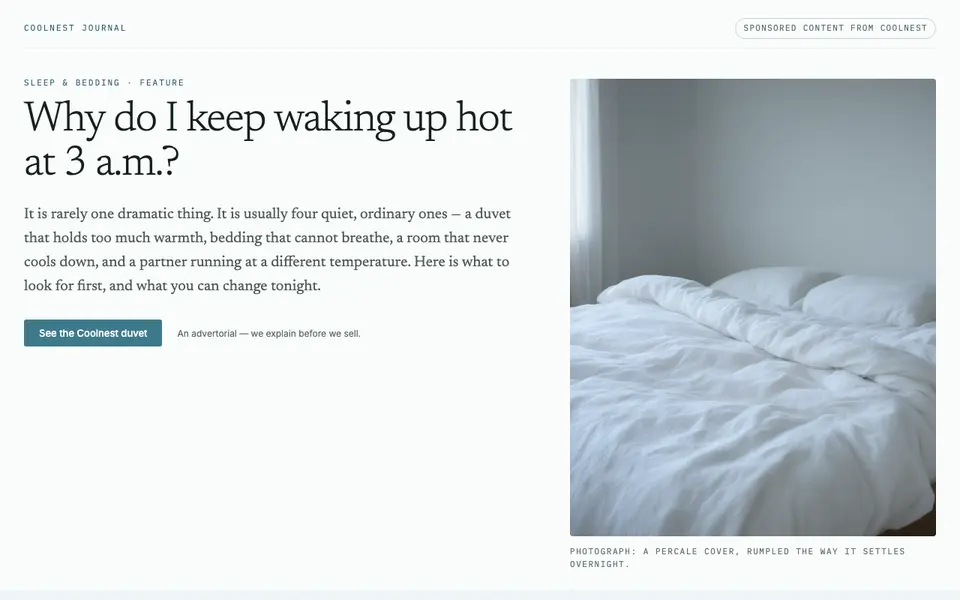
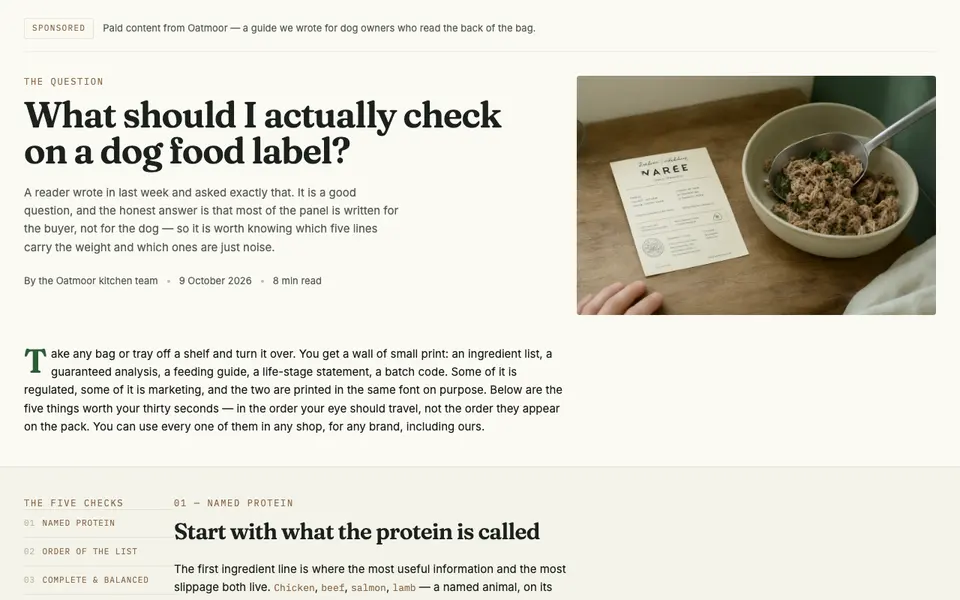
Both pages below were made for fictional brands selling a real kind of product. Each is built around one question a buyer already has; the first half answers it with advice anyone can use, and the product appears only in the second half, as one option.