What is an advertorial?
An advertorial is a page that reads like an editorial article but is paid for by a brand and leads to its product. In paid advertising it usually sits between the ad and the product page, which is why it is also called a pre-sell page or pre-lander. For the full definition, paid placements versus your own pages and when to use one, see what is an advertorial.
When an advertorial is worth writing
An advertorial adds a step between the click and the offer, so it has to earn that step. It usually does when:
- The product needs explaining: a new category, an unfamiliar ingredient or a mechanism people have not seen before.
- The reader has the problem but is not looking for a product yet, as with most traffic from social feeds and native ad networks.
- Your difference only makes sense once the reader understands what usually goes wrong.
- The price needs context: the product costs more than the obvious alternative, for a reason that takes a paragraph to explain.
If people already search for your product by name, or they come back from a retargeting ad, send them straight to the product page. They do not need to be persuaded twice.
Five advertorial formats
Pick the format from the reader’s situation, not from what is fashionable. Each one sets up the product differently.
| Format | Works best when | Typical headline |
|---|---|---|
| Listicle | There are several separate reasons to buy or signs of a problem | 5 reasons… / 7 signs… |
| Buying guide | The reader is comparing options and needs criteria | What to look for in… |
| Comparison | There is a familiar alternative the reader already uses | X vs Y: which one… |
| Review | One product, tested against a clear need | I tried… for 30 days |
| Founder story | The reason the product exists is the selling point | Why we started… |
A buying guide works well for products with many look-alikes, because it hands the reader criteria your product happens to meet. A listicle suits impulse purchases and problems with several causes. A review or founder story needs a real person behind it; do not invent one.
The structure of an advertorial, section by section
- Sponsored label and headline. Say it is sponsored. The headline picks up where the ad left off and names the reader’s problem, not the product.
- Opening. Two or three short paragraphs that show you understand the problem and who has it.
- Explanation. Why the usual fixes fall short and what actually matters. This is the part readers came for, so give it the most space.
- The product, introduced as an answer to what you just explained, with evidence you can support: ingredients, how it works, genuine reviews.
- Objections. Price, effort, “will it work for me”, what happens if it does not.
- One call to action to the product page or offer, repeated at the end.
An example, taken apart
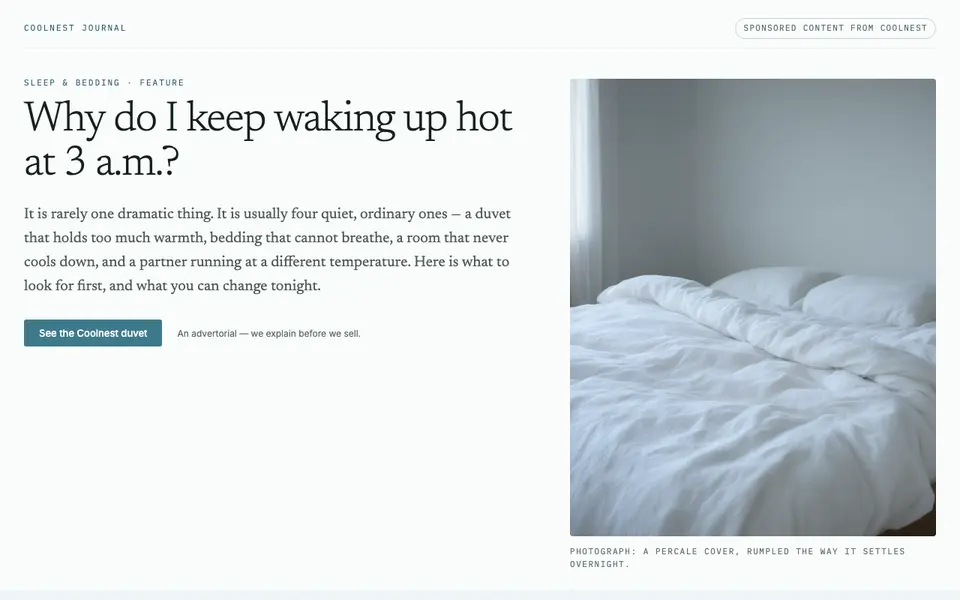
This example follows the structure above. The headline is the reader’s own question: “Why do I keep waking up hot at 3 a.m.?” The first half explains four ordinary causes of a warm bed and six free changes to try tonight, so the article is useful even to someone who never buys. Only then does the duvet appear, introduced as the next step “if the list above did not fix it”. The page ends with the trial terms and a single action.
Giving away free fixes before the product can feel risky. It is what makes the product section credible: by that point the reader has seen that the article is on their side.
How to write it, step by step
- Choose one reader and one question. “Busy parents” is not a reader. “Someone who wakes up hot at night and has already tried a fan” is.
- Collect what you can support. Product facts, ingredients, test results, genuine customer quotes. Everything the article claims has to come from here.
- Write the headline and opening first. Match the promise of the ad that sends traffic to the page. If the ad asks a question, the headline repeats it.
- Explain before you sell. Write the explanation as if there were no product. If that part is not worth reading on its own, the rest will not work.
- Bring in the product as the answer. One section, specific, with the evidence you collected.
- Keep one call to action. One offer, one destination. Repeat the same link rather than adding new ones.
- Read it on a phone. Visitors from social feeds usually arrive on a phone. Check that paragraphs are short, images load and the link is easy to tap.
Common mistakes
- Selling in the first paragraph. Readers notice, and the page turns back into an ad.
- A headline that does not match the ad. Visitors who do not find what the ad promised leave immediately.
- Several offers on one page. A second discount or a second product splits attention and weakens both.
- Claims you cannot back up. Invented statistics, fake reviews or medical promises put the brand and the ad account at risk.
- Hiding that it is sponsored. Advertising rules and ad platform policies in many markets require clear disclosure. Check the rules where you advertise.
Checklist before you publish
- The page is labelled as sponsored or advertising.
- The headline matches the ad that links to it.
- The opening is about the reader’s problem, not the product.
- The explanation would be useful even without the product.
- Every claim comes from your product materials or a source you can show.
- Reviews and quotes are from real customers, used with permission.
- There is one offer and one destination, and every link goes there.
- The page reads well on a phone, and the first screen is not just an image.
- The link to the offer works and lands on the right product or variant.