What a listicle advertorial is
A listicle is an article built as a numbered list. A listicle advertorial uses that format to sell: it is paid for by you, labelled as sponsored and leads to your offer. It is a common choice for paid social and native advertising, because a numbered headline promises a quick, skimmable read and the reader can see how long it is before they start.
For a seller, the list format has one more advantage: it breaks a sales argument into separate points, each of which can be read on its own. A reader who skims still picks up several reasons, rather than the first paragraph of one long argument.
When a listicle is the right format for your product
- There are several separate reasons to buy, and none of them is enough alone.
- The problem has several signs or causes that readers recognise in themselves.
- The purchase is quick to decide: everyday products, gifts and lower-priced items where the reader does not need a long explanation.
- Your traffic comes from feeds, where readers arrive with little time and a numbered headline earns the click.
Choose a different format when your argument is one connected story — a new mechanism that has to be explained step by step reads better as a buying guide or an explainer. The formats are compared in how to write an advertorial.
Two ways to place your product in the list
| Problem list, product at the end | Reasons list, product throughout | |
|---|---|---|
| Typical headline | “7 signs your running shoes are worn out” | “5 reasons runners are switching to…” |
| What the items are | Signs, causes or mistakes the reader recognises | Benefits or differences of your product |
| Where the product appears | After the list, as the answer to what it described | In every item, from the first one |
| Suits | Readers who have the problem but are not shopping yet | Readers who already know the category and are comparing |
| Main risk | The list is so useful that readers leave before the product | It reads as an ad from the first line |
If you are unsure, start with the problem list. It is more honest to the reader and less likely to read as an ad; once it works, test a reasons version against it.
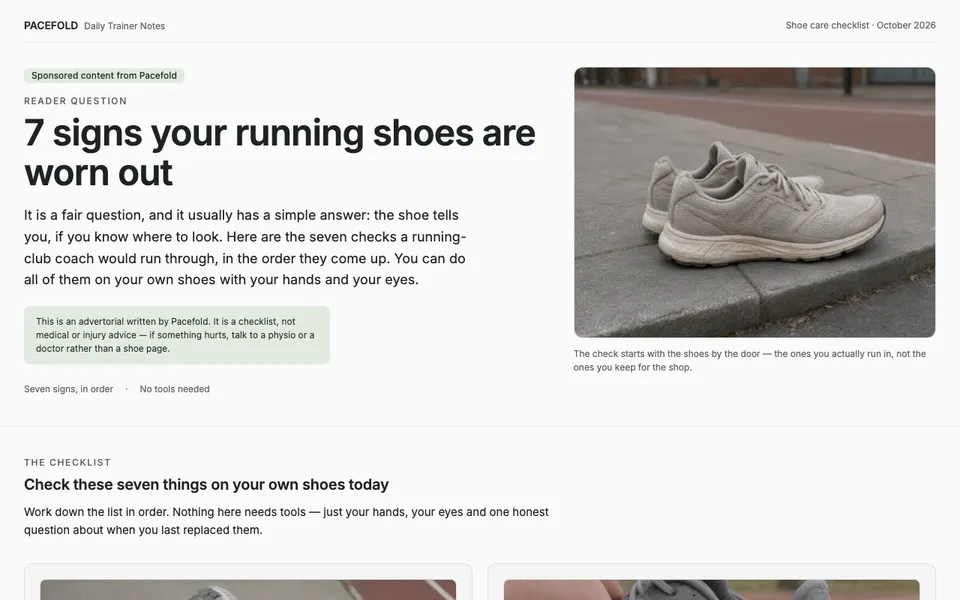
How many items to use
Use as many items as you have genuinely different points, and no more. As a starting point, aim for five to ten. Fewer can look thin for a list; more tends to repeat itself, and the reader stops before the end — which is exactly where a problem list puts your product.
Put the strongest or most surprising item first, to reward the click, and the one that leads most naturally to your product last.
How to write each item
- A heading that makes the point on its own. “The tread on the outside edge is smooth” is better than “Check the tread”. Skimmers read only the headings.
- Two to four sentences of explanation: why it matters and how the reader can check it for themselves.
- One image that shows exactly what the heading says.
- The reader, not the product, as the subject. In a problem list, the product is mentioned in the last item at the earliest.
Every item must be true and checkable. A list makes it tempting to pad with weak points or invented figures; one item the reader does not believe undermines the rest.
From the last item to the offer
- Bridge from the list. One short paragraph that connects what the reader just recognised to what your product does differently.
- Product section: what it is, the two or three points that answer the list, the price and what reduces the risk — a trial, a guarantee, free returns.
- One action, with the same wording and destination every time it appears.
Listicle headlines that fit an advertorial
| Pattern | Use it when |
|---|---|
| “[Number] signs you need a new [product]” | The product wears out or gets outgrown |
| “[Number] mistakes people make with [task]” | Your product removes a common mistake |
| “[Number] things to check before you buy [category]” | The reader is about to choose |
| “[Number] reasons [audience] are switching to [category]” | You are writing a reasons list |
Whatever pattern you use, the headline should repeat the promise of the ad that sends the traffic, and the number in it should match the number of items on the page.
Designing a listicle page
- Make the numbers visible. Large numerals or numbered headings let readers see their progress through the list.
- Keep every item the same shape: heading, image, short text. Consistency makes the page fast to scan.
- Hold the product back visually as well as in the text. No prices or buy buttons inside the list in a problem-list version.
- On phones, each item should fit on about one screen, and a slim action bar can appear once the product has been introduced.
The rest of the layout follows the same rules as any advertorial — see advertorial design and how to lay out an advertorial for mobile readers.