Why the two are not opposites
“What is an advertorial” is a question about money: a brand paid for the page, it leads to that brand’s product, and it is labelled as sponsored. “What is a listicle” is a question about form: an article built as a numbered list. A sponsored “7 signs your running shoes are worn out” is both at once — a listicle advertorial.
So the question sellers are really asking is narrower: should the page behind my ad read as one article, or as a numbered list? Instead of answering it in the abstract, we took one of our own article-style pages and rewrote it as a list.
The page we started from
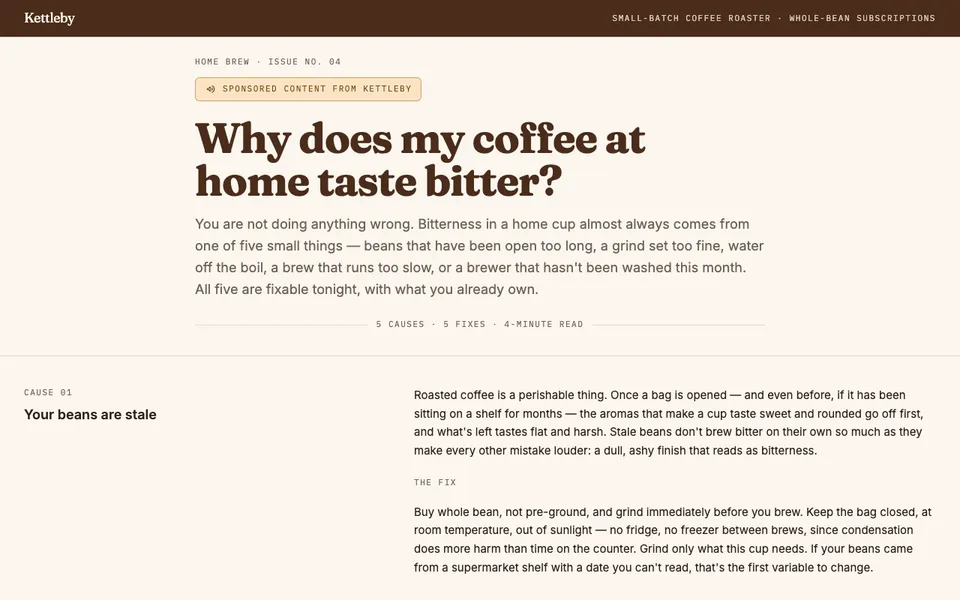
The page answers “Why does my coffee at home taste bitter?” Its parts, top to bottom:
- A sponsored label and the question as headline, followed by a reassuring opening: “You are not doing anything wrong.”
- Five causes, each with a fix: stale beans, a grind that is too fine, water that is too hot, a brew that runs too long, a brewer that needs cleaning. Each is labelled “Cause 01” to “Cause 05”.
- A recap, “Five things to change tonight”, one line per cause.
- A turn back to the first cause: four of the five can be fixed at home; the fifth, stale beans, is about where the bag comes from. Here the page says plainly that it is paid for by the people who sell the beans.
- The product and offer: whole beans roasted within 3 days of shipping, every two or four weeks, first bag 30% off, and one button, “Try your first bag”.
- A second recap and the button again, then a footer that repeats that the article is sponsored.
Notice that the explanation is already five separate points. That makes it a good test case: the rewrite should be easy, and whatever still has to change is the real difference between the formats.
The listicle rewrite, part by part
| Part | Article (live page) | Listicle rewrite | Why |
|---|---|---|---|
| Headline | “Why does my coffee at home taste bitter?” | “5 reasons your coffee at home tastes bitter — and the fix for each” | A question promises an answer; a number promises a length. The promise underneath stays the same. |
| Opening | Reassurance, then all five causes named in one sentence | Reassurance, then how to use the list: check one thing per brew | A list does not need a preview of its own contents; the numbers are the preview. |
| Order of the points | Stale beans first, cleaning last | Cleaning first, stale beans last | In a listicle the last item leads into the product. The product answers stale beans, so that cause moves to the end. |
| Each point | “Cause 01”, a heading, an explanation, “The fix” | A large number, the same heading, explanation and fix | Almost nothing. The headings already made their point on their own, which is what a list needs. |
| Recaps | Two: “Five things to change tonight” after the causes, and “The five fixes, in one list” near the end | Both cut | The list is already the recap. Repeating it makes the page longer without telling the reader anything new. |
| Turn to the product | Goes back to the first cause | Follows straight on from item 5 | Because stale beans is now the last item, the page no longer has to jump back four sections. |
| Product, offer, button, footer | Roasted within 3 days of shipping, first bag 30% off, “Try your first bag” | Unchanged | The format decides how the reader gets here, not what they find. |
The listicle version is shorter by two recaps and has one transition fewer. The article version has something the list loses: the moment where it returns to cause one and admits who paid for the page reads as a deliberate turn, because the reader has to be brought back to it.
What the rewrite did not touch
- The sponsored label at the top and the disclosure in the footer.
- The facts: the same five causes, the same fixes, nothing added to make the list longer.
- The product section and the offer, word for word.
- The single call to action, with the same text and destination.
That is the practical answer to advertorial vs listicle: the format lives in one block, the explanation. Everything else is shared, which is how the advertorial template is laid out — and the parts around the copy are covered in the presell page template.
Which version we would send traffic to
For this page, the deciding factor is the ad. An ad that asks “Why does your coffee taste bitter?” should land on the article, which answers that question in its headline. An ad that says “5 reasons your coffee tastes bitter” should land on the list, with five items. Beyond that:
- Feed traffic leans towards the list. Readers who arrive from a social feed see in the headline how long the read is and can skim the numbered headings.
- Newsletter or publisher traffic leans towards the article. Those readers arrived to read, and the article’s turn back to the first cause works on readers who are following along.
- Some pages should not be rewritten at all. When the case for a product is one chain of reasoning — a mechanism readers have not heard of, explained step by step — numbering the steps makes them look like separate claims and breaks the argument. Keep those as articles.
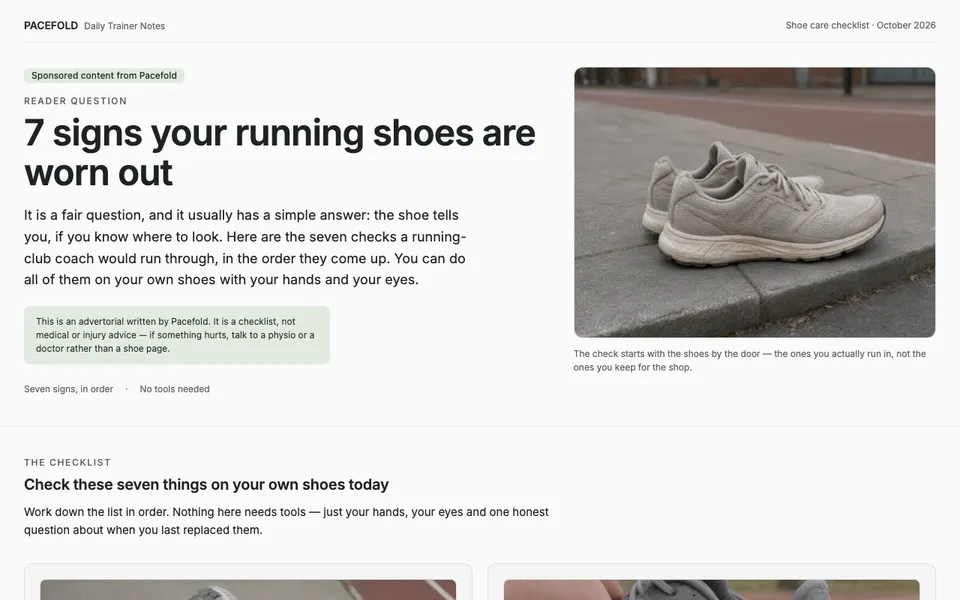
The other article formats — buying guide, comparison, review — go through the same choice; they are compared in how to write an advertorial.
Testing the two versions
Because the rewrite leaves everything but the explanation alone, the two versions make a clean test: same ad, same audience, same offer, same product page. Compare how many visitors click through to the offer and how many of those buy, not how long they read. Check both at phone width before you start — see mobile advertorial layout. Whether to use a pre-sell page at all is a separate test, covered in pre-sell page or product page.